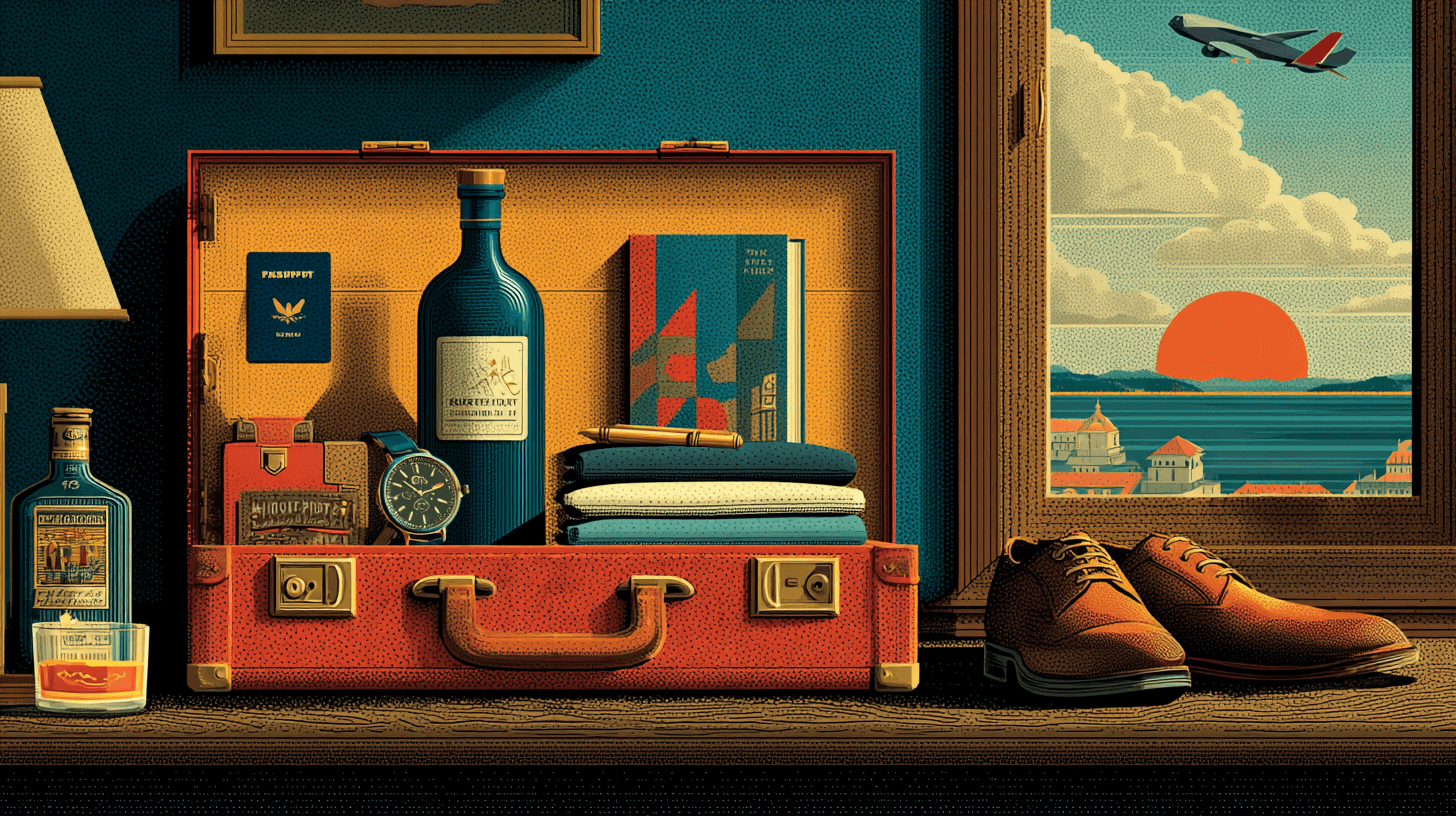
Home Bar: Six Bottles, No More

A great home bar is not a collection. It's an edit. The difference between a bar cart that impresses and one that merely occupies space is the same difference between a well-curated wardrobe and a closet full of clothes — it's not about how much you have, it's about whether every bottle earns its place.
This is our guide to building a home bar that would make a hotel bartender nod in approval. Not a comprehensive encyclopedia of spirits, but a deliberate, opinionated selection of what to buy first, what to add later, and what to skip entirely.
The Foundation: Six Bottles
A home bar that can produce 80% of classic cocktails needs exactly six bottles. This is not a suggestion — it's arithmetic. These six spirits, combined with citrus, sugar, and ice, cover the Martini, the Manhattan, the Negroni, the Daiquiri, the Margarita, the Old Fashioned, and dozens of variations.
**Gin.** Tanqueray or Beefeater for a London Dry that mixes beautifully without demanding attention. If you want something more botanical, Hendrick's or Roku. Never start with a navy-strength gin unless you know what you're doing — it will overpower everything.
**Bourbon.** Buffalo Trace is the answer to a question nobody should overthink. It's excellent neat, superb in an Old Fashioned, and costs less than most bottles half its quality. Maker's Mark is the alternative if you prefer wheated bourbon's softer profile. Leave the allocated bottles for collectors — a home bar rewards consistency, not rarity.
**Rye Whiskey.** Rittenhouse Bottled-in-Bond. Full stop. This is the cocktail bartender's rye — 100 proof, rich, spicy, and under $30 in most markets. It makes a Manhattan that will ruin you for lesser versions. If you can find Sazerac Rye, buy two.
**Blanco Tequila.** Fortaleza or Siete Leguas — both still made with traditional tahona-crushed agave, both clean enough for a Margarita and complex enough to sip. Avoid anything that costs less than $30 — cheap tequila is the enemy of good cocktails and worse mornings.
**White Rum.** Probitas (if you can find it) or Plantation 3 Stars. Light rum is the most underrated spirit in the home bar — it's the backbone of the Daiquiri, which is the cocktail that separates people who can bartend from people who own a shaker. A Daiquiri made with good rum, fresh lime, and simple syrup is the single best test of a home bar.
**Campari.** Not negotiable. Campari is the sixth bottle because it unlocks the Negroni, the Boulevardier, and the Americano — three cocktails that define the aperitivo hour. There is no substitute. Aperol is not a substitute. It's a different drink for a different mood.
“A home bar with six excellent bottles will outperform a home bar with thirty mediocre ones. Every time.”
The Modifiers: Four Bottles
Once the foundation is set, four modifiers transform your six-bottle bar into a serious operation.
**Sweet Vermouth.** Carpano Antica Formula. The most important modifier in cocktails — it's in the Manhattan, the Negroni, and the Vieux Carré. Carpano Antica is richer and more complex than Dolin or Cocchi di Torino (both excellent, both more affordable). Refrigerate after opening. This is not optional — vermouth is wine, and wine oxidizes.
**Dry Vermouth.** Dolin Dry or Noilly Prat. Essential for a proper Martini. The ratio is personal — start at 4:1 gin-to-vermouth and adjust. If you're making Martinis with a rinse of vermouth and calling it sophisticated, you're making cold gin. Which is fine, but it's not a Martini.
**Orange Liqueur.** Pierre Ferrand Dry Curaçao or Cointreau. The Margarita needs it. The Sidecar needs it. A dozen tiki drinks need it. Cointreau is the safe choice; Pierre Ferrand is the bartender's choice.
**Angostura Bitters.** The original and still essential. Three dashes in an Old Fashioned, two in a Manhattan. A bottle lasts months. Buy it once, use it constantly, wonder how you ever made drinks without it.
The Tools: Five Things
The home bar industry wants to sell you a 47-piece cocktail set in a leather case. You need five things.
**A Boston shaker.** Two tins, no glass. Glass breaks. Tins don't. They also chill faster and seal better. The Koriko weighted set is what most professional bartenders use. It costs $30 and will outlast every relationship you have.
**A mixing glass.** Yarai-style, Japanese, crystal cut. This is for stirred drinks — Martinis, Manhattans, Negronis. The weight of a proper mixing glass matters; it keeps the vessel cold and gives the stirring a satisfying heft. Don't use a pint glass.
**A jigger.** Japanese-style, double-sided, 1oz/2oz. Measure everything. Free-pouring is for people who don't care what their drinks taste like. Leopold makes a beautiful one. The OXO angled version is more practical. Either works.
**A Hawthorne strainer.** For shaken drinks. The spring catches ice and pulp. Cocktail Kingdom's basic model is perfect.
**A bar spoon.** Long, twisted stem. For stirring and measuring (the bowl is roughly a teaspoon). The twist matters — it guides the rotation of the liquid around the mixing glass. It's physics, not performance.
The Ice
Ice is not a detail. It's an ingredient. Bad ice ruins good cocktails the way bad water ruins good coffee — invisibly and completely.
The home bar needs two types of ice: large cubes (2-inch, for stirred drinks and spirit-forward cocktails) and standard cubes (for shaking). Crushed ice is nice for juleps and swizzles but not essential at the start.
The Tovolo King Cube tray makes excellent 2-inch cubes. Two trays, rotated through your freezer, will keep you supplied. If you're serious, a Clinebell or Japanese-style directional freezing setup produces crystal-clear ice that melts slower and looks extraordinary — but this is a Phase 2 investment.
“Ice is the most overlooked ingredient in home cocktails. A $50 bottle of bourbon poured over cloudy, freezer-burned ice cubes from a bag is a $50 mistake.”
The Glassware: Three Types
You don't need a different glass for every cocktail. You need three.
**A coupe.** Not a Martini glass — a coupe. The wide, shallow bowl is more stable, more elegant, and works for Martinis, Manhattans, Daiquiris, Sidecars, and anything served up. Vintage coupes from estate sales are more beautiful than anything you'll buy new.
**A rocks glass.** Also called a lowball or Old Fashioned glass. Heavy-bottomed, 8-12oz. For Old Fashioneds, Negronis on the rocks, and anything served over ice. The weight matters — a good rocks glass should feel substantial in your hand.
**A highball.** Tall, thin, 10-12oz. For Gin & Tonics, Highballs, and Americanos. Japanese highball glasses (the tall, narrow ones) are the gold standard — they keep the carbonation lively and look beautiful. Toyo-Sasaki makes the classic version.
What to Skip
The home bar is full of things that seem essential but aren't. A guide to not buying:
**Flavored vodkas.** All of them. If you want flavor, use a flavored spirit that was designed that way — gin is flavored vodka done correctly.
**Pre-made mixers.** Sour mix, Margarita mix, Bloody Mary mix. These are the enemy. Fresh citrus, simple syrup, and good spirits produce better cocktails than anything in a bottle with a pour spout.
**Novelty bitters.** You need Angostura. Eventually you'll want Peychaud's (for Sazeracs) and orange bitters (for improved cocktails). You do not need chocolate bitters, coffee bitters, or sriracha bitters. You especially do not need all three.
**A blender.** Unless you're making frozen drinks daily. A shaker with good ice produces a texture that a blender cannot — colder, more diluted in exactly the right way, with a frothy top that a blended drink will never achieve.
The Clipper Briefing
Total investment for a complete home bar: approximately $400–600 for spirits, $100–150 for tools and glassware. This is less than two rounds of cocktails at a London hotel bar — and it will produce hundreds of drinks at a fraction of the cost.
Build the six-bottle foundation first. Add vermouth and Campari second. Buy the tools. Then stop. Live with these bottles for a month. Make the same four cocktails — Old Fashioned, Negroni, Daiquiri, Martini — until you can make them without thinking. Then expand.
The home bar, like travel, rewards intention over accumulation. Own less. Know it well. Pour it with care.
Enjoyed this? Get The Dispatch.
Travel intel, cocktail notes, and first-class reviews — every Thursday.